
Core movement
Stance, balance, footwork, guards and clean lines. The stuff that makes everything else work.
Training
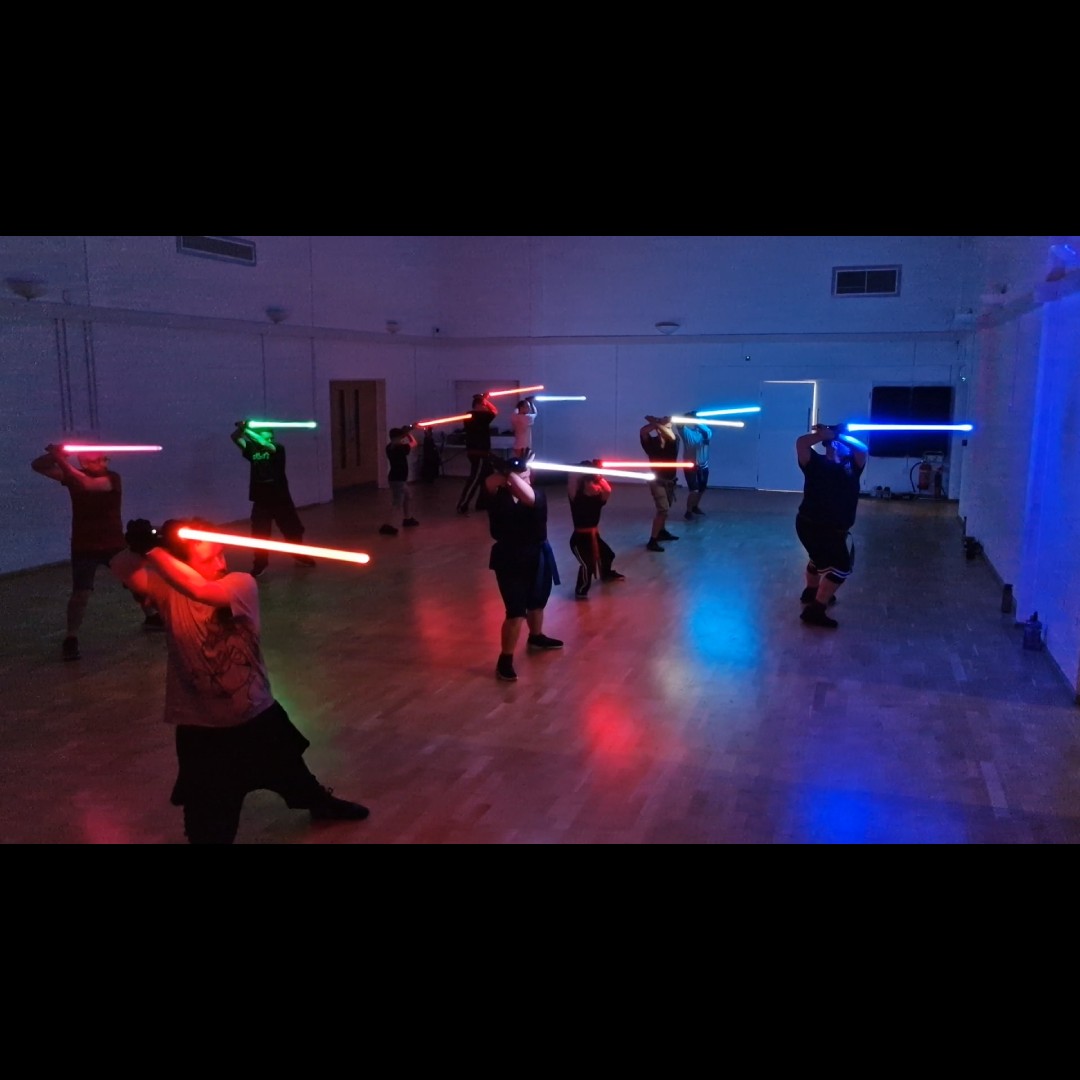
We warm up, drill, laugh, move, pair up, try things, mess things up, fix them, and slowly become a little bit better than we were last week.
8:15-9:30pm
Hermitage Park Community Centre, Allington, Maidstone.
Foundations
Foundations are where we build the good habits: how to move, how to strike, how to keep each other safe, and how to look just a little bit cooler every week.
Stance, balance, footwork, guards and clean lines. The stuff that makes everything else work.
Earth, Fire, Water, Air and Lightning drills help your body learn the language of the saber.
Control, distance and communication first. The goal is to learn together, not flatten your new friends.
What should I expect?
Every session is built to help you move better, learn safely and enjoy the exchange. Some parts are solo, some are cooperative, and anything involving sparring is introduced gradually.
Drills are cooperative rather than competitive. They are designed to improve balance, coordination, timing, footwork and control. They build cardio, confidence and muscle memory, and they form the foundation for everything else we do.
This is where we learn techniques from the syllabus: guards, strikes, footwork, partner exercises and the principles behind them. You will gradually build your technical skills over time.
Combat means safe, controlled sparring with another person. It is not about beating people up. It is about applying technique, learning from one another and enjoying the exchange.
You will not spar until you have learned the basics of safe attacks, defences and footwork. At first you will work with instructors, then with senior students. Once you reach Apprentice level and we have seen that you can spar safely and with control, you can spar with other Apprentices.
Kata is the other path. These are structured sequences of movement that combine techniques into flowing forms. Some members prefer kata, some prefer combat, and many enjoy both. There is no right answer. Follow the part of the art that you enjoy.
Pick your flavour
Kata gives you a solo path to practise. You will build clean movement, memory, rhythm and your own little spark of style.
Combat is exciting, but it is not chaos. We work on timing, distance, choices and control so both people leave smiling.
Style combat is teamwork. You and your partner build readable, dramatic exchanges where everyone gets to shine.
Flow work is great if you want fitness, confidence and movement without jumping straight into sparring.
A usual Wednesday
We get bodies moving, wake up the joints and shake off the day.
We pick one idea and give it time to settle in properly.
You practise with another human, which is where the real learning happens.
We finish with sparring, kata, style combat, games or a focused challenge.
Find your route
No stress. Answer three tiny questions and we will point you toward a friendly first-visit route.